


Engineering &
Manufacturing Translation
When a translation is wrong in a document, someone reads the wrong words. When it is wrong in a manual, someone does the wrong thing.


Engineering and manufacturing translation:
every document has to be as reliable as the product it describes.
A global engineering or manufacturing company does not just make things. It documents them, sells them, operates them, maintains them and employs thousands of people across multiple countries to do it. Every one of those activities produces content that has to work in more than one language. Product manuals. Safety procedures. HR policies. Marketing brochures. Corporate communications. The content is varied, the volumes are high and the consequences of getting any of it wrong range from brand damage to operational failure.
Most of this content can be produced efficiently using AI-assisted translation workflows, with human expertise applied at the right points. But some of it cannot. A safety procedure translated by AI without specialist review is not a safe procedure. An HR policy that reads as impersonal or culturally tone-deaf in the target language creates exactly the problems it was written to prevent. Knowing which content needs what level of care is what an experienced translation partner brings. We have worked with engineering and manufacturing companies for over twenty five years and we know the difference.
Every type of content.
The right level of care for each.

When the translation has to be as reliable as the product

Subject specialists, not just linguists

AI-assisted workflows for high-volume technical content

HR content that works for a multilingual workforce

Marketing and brand content for industrial companies

Consistency across every document and every market

DTP and multilingual document production

A partner who understands the volume and pace of industrial content
Engineering and manufacturing translation across every content type your business produces.
From safety-critical technical documentation to product marketing and internal HR communications, each content type has different requirements and a different cost of failure. We match the workflow to the content.
Take a look at our
recent projects.


Manufacturing translation into
every major industrial market.














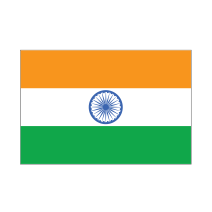
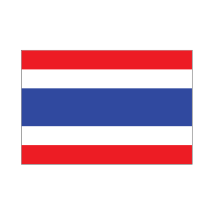
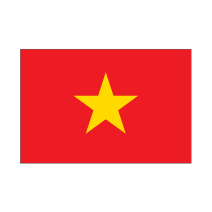

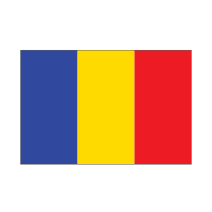







Engineering and manufacturing companies operate in markets where the language requirements are shaped by where the product is sold, where it is made and where the workforce is based. A company selling industrial equipment into Germany, France, China and Brazil needs translation that reflects the technical and regulatory standards of each market, not just the language.
We translate engineering and manufacturing content across all major markets, with native-speaking specialists selected for subject knowledge as well as language. Translation memories ensure consistency across every document and every project over time.
What engineering and manufacturing companies ask us about translation
Translation buyers in engineering and manufacturing typically want to know two things: how do we handle the technical complexity, and how do we manage the cost and volume. We have answered both, along with the questions about AI that come up in almost every conversation.
A dedicated account manager oversees your account across all content types and languages. They maintain your glossary and translation memory, brief linguists consistently, manage deadlines across simultaneous projects and handle the coordination that large volumes of multilingual content require. The goal is to remove the burden of managing translation from your team, not add to it.
AI translation has an important role in engineering and manufacturing content, but that role requires human oversight. Safety documentation, technical manuals and installation procedures can all be translated using AI-assisted workflows, provided a qualified subject specialist reviews and corrects the output. The risk is not AI. The risk is unchecked AI. A fluent translation that contains a technical error looks correct to anyone who does not know the subject. The maintenance engineer in the field does not know. They follow the document. Marketing and brand content is a different matter: AI cannot reliably deliver brand voice, cultural nuance or creative judgment, and the output shows. For that content, human translation is the right starting point, not a quality check at the end.
Yes. HR content requires cultural awareness as well as linguistic accuracy. A policy translated correctly but in the wrong register for the target culture reads as impersonal, legalistic or dismissive, none of which is the intent. We work with linguists who understand the HR context in the target market, not just the language, and who can adapt tone appropriately while maintaining the meaning and intent of the original document.
We select linguists on subject knowledge as well as language. For engineering and manufacturing content we work with linguists who have backgrounds in mechanical engineering, electrical engineering, industrial manufacturing and related disciplines. A linguist who does not understand what they are translating cannot reliably translate it, regardless of their language skills. We do not assign general translators to specialist technical content.
We build and maintain a subject-specific glossary and translation memory for every client. This means the same term is used consistently across every document, every language and every project, regardless of when the work is done or which linguist handles it. For engineering and manufacturing clients with large product ranges, this compounds in value over time: the more we translate, the more consistent and efficient the output becomes.
The decision turns on what the content is trying to do. Technical and safety documentation can be handled efficiently with AI-assisted translation where a human specialist reviews the output for accuracy and terminology. HR communications and internal content work well with the same approach, with closer human attention for anything sensitive or complex. Marketing and brand content needs to be human-led from the start: brand voice, tone and cultural resonance cannot be reliably added at the post-editing stage. We advise on the right approach for each content type before the project begins, not after the budget has been spent on the wrong workflow.
Yes. We handle multilingual desktop publishing in-house for InDesign, Word and PDF documents. Technical manuals are often complex layouts with diagrams, callouts, numbered procedures and multiple columns. Translated text expands or contracts significantly between languages, which breaks layouts built for English. We return documents that are ready to publish, not translations that need rebuilding by a separate DTP team.
Insights for engineering and manufacturing companies working across languages
Practical thinking on technical translation, AI-assisted workflows and multilingual content production for industrial companies.


