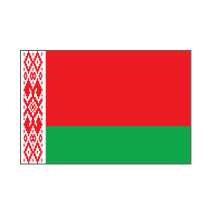
Belarusian Translation Services
Yanka Kupala's poetry helped establish Belarusian as a literary language of its own in the early twentieth century. Belarusian is a distinct East Slavic language, not a variety of Russian, with its own grammar, vocabulary and literary tradition. Russian translation does not serve a Belarusian audience.

Brightlines provides Belarusian translation services for clients across the UK and internationally. As a UK translation agency, Brightlines works with legal and immigration firms serving Belarusian-speaking clients, NHS trusts and healthcare bodies communicating with Belarusian-speaking patients, local authorities and public-sector bodies serving Belarusian-speaking residents, NGOs and humanitarian organisations working with Belarusian communities and diaspora and organisations with Belarusian-speaking workforces. Brightlines matches every Belarusian project to a translator with native Belarusian command and confirmed sector experience.
Belarusian at a glance
- Script: Cyrillic alphabet, with the distinctive letter ў (u with breve) that Russian does not use. A Latin-script system called Łacinka is used historically and by some diaspora publications, but Cyrillic is the standard. Two orthographic standards exist within Cyrillic: Narkamaŭka (the official post-1933 standard, closer to Russian) and Taraškievica (the classical 1918 standard, used by diaspora and cultural publications).
- Speakers: Approximately 5 million native Belarusian speakers in Belarus, with substantial diaspora communities in Poland, Lithuania, Russia, Ukraine, the United States, Canada and the UK. Active daily use of Belarusian is smaller than native-speaker figures suggest, as most Belarusians are bilingual and often use Russian in daily life. UK Belarusian communities have grown significantly since 2020.
- Grammar and structure: Belarusian is an East Slavic language, related to Russian and Ukrainian, but distinct in vocabulary, phonology and orthography. It uses a six-case grammar (nominative, genitive, dative, accusative, instrumental, locative), three grammatical genders and a verbal aspect system distinguishing completed and ongoing action. Word order is more flexible than English because case markings do the work of English word order.
- Translation risk: The most consistent commissioning error for Belarusian is treating it as a variant of Russian. Belarusian is a separate East Slavic language with its own vocabulary, orthography and cultural register. Content produced in Russian for a Belarusian audience reads as belonging to another market, and Belarusian audiences (particularly diaspora communities) are attuned to the distinction. The choice between the two orthographic standards (Narkamaŭka or Taraškievica) also matters and needs to be agreed at brief stage.
- AI suitability: AI training data for Belarusian is sparse compared to Russian, and AI output for Belarusian frequently contains Russian-influenced vocabulary, incorrect orthography, grammatical errors and inconsistencies between the two orthographic standards. Human review by a Belarusian translator is required on every project.
How clients use our Belarusian translation services
- Legal, immigration and certified translation: certified translations of personal documents, immigration and asylum documentation, witness statements and legal correspondence for legal and immigration firms with Belarusian-speaking clients, plus certified translations for UK Home Office, UKVI and court purposes. Specialist Led Translation is required because certified translations for UK official purposes must meet UK certification standards, and Belarusian legal terminology follows conventions distinct from Russian.
- Healthcare and public-sector content: patient information, appointment letters, public health content and local authority communications for NHS trusts, local authorities and public-sector bodies serving Belarusian-speaking residents in the UK. Specialist Led Translation for structured medical and public-sector content; Creative Translation for community-facing communications where register and cultural fluency matter.
- NGO, humanitarian and community content: programme documentation, humanitarian communications and community-facing materials for UK NGOs and humanitarian organisations working with Belarusian communities and diaspora. Specialist Led Translation for structured programme documentation and Creative Translation for community-facing content where register and cultural fluency matter.
What you get with Brightlines
Belarusian translators matched to sector and orthographic standard
For you: translators native to Belarusian, matched to the content type, with the orthographic standard confirmed for the deliverable.
Brightlines works with Belarusian translators who are native speakers and hold professional experience in the relevant content sector. A legal and certified translation specialist brings familiarity with UK Home Office requirements and the conventions Belarusian personal documents use. A healthcare translator brings command of Belarusian medical terminology and the accessible register patient-facing content demands. Belarusian is a smaller specialist field than the major East Slavic commercial languages, and Brightlines works with translators who genuinely have both native command and sector experience.
Human-led review of Belarusian grammar, orthography and Russian-language distinction
For you: case accuracy, orthographic consistency and Belarusian vocabulary confirmed before delivery, not after audience feedback.
All Belarusian translation work at Brightlines goes through a human review stage that checks case accuracy, gender agreement, verb aspect, orthographic consistency (whether Narkamaŭka or Taraškievica is used for the deliverable), register appropriateness and vocabulary against the project brief. The review confirms that the content reads as Belarusian rather than as Russian with Belarusian orthography, and that terminology aligns with the target standard.
Get a quote for Belarusian translation services in the UK
Brightlines is a UK translation agency providing Belarusian translation services to legal and immigration firms, NHS trusts and healthcare bodies, local authorities and public-sector bodies, NGOs and humanitarian organisations and organisations with Belarusian-speaking audiences in the UK and internationally. We work with legal and certified translation, healthcare and patient communications, public-sector communications, NGO and humanitarian programme materials and community-facing content, matching every project to a translator native to Belarusian and the relevant content sector. If you need Belarusian translation that reads as Belarusian rather than as Russian-adjacent, talk to us about your project.


Sound local in every language.
If your content has to sell, persuade, reassure, or build trust, the choices between the words matter. We keep a human in control on every project, then use supportive tools only where they genuinely help. The result is writing that reads cleanly, stays consistent, and sounds like you, not a template.

Industry Experience

International Reach

Speed & Accuracy
Supported
Languages
We support a wide range of languages, from major global markets to specialist regional languages.