German Translation Services
Goethe spent decades revising Faust in pursuit of precision, and that instinct runs through German as a written language. Every noun is capitalised. Every compound word encodes a distinct meaning. Translated copy that is fluent but structurally imprecise will read as foreign to a German audience.

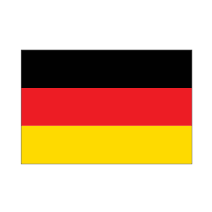
Brightlines provides German translation services to UK and international clients in standard High German (Hochdeutsch), Swiss German and Austrian German. Work spans brand and marketing copy, technical and legal documentation, publishing translation and operational content at scale, each project matched to the correct regional variety, register and formality level.
German at a glance
- Script: Latin alphabet, 26 letters plus four additional characters: the umlauted vowels ä, ö, ü and the ligature ß (Eszett or sharp s). Swiss Standard German does not use ß: it is replaced throughout with ss.
- Speakers: Approximately 90 million native speakers in Germany, Austria and Switzerland, with German an official language in all three countries as well as Liechtenstein and Luxembourg.
- Varieties: Standard German (Hochdeutsch) is the written and formal standard used in Germany and Austria. Swiss Standard German (Schweizer Hochdeutsch) diverges in vocabulary, spelling (no ß) and some grammatical preferences. Austrian German carries distinct vocabulary items in official, commercial and everyday use.
- Grammar: German has three grammatical genders (masculine, feminine, neuter) that affect every article, adjective and pronoun in a sentence. Nouns are capitalised throughout, regardless of position. Incorrect gender or capitalisation is immediately visible to a native reader.
- Compound words: German creates compound nouns by combining existing words without spaces, such as Krankenversicherungsbeitrag (health insurance contribution) and Bundesverfassungsgericht (Federal Constitutional Court). These compounds encode precise meaning. In technical, legal and official translation, compound word choice is a precision requirement, not a stylistic decision.
- Address forms: German distinguishes formal Sie and informal du (both mean 'you'). Sie is standard in business and professional correspondence. In consumer marketing, the choice signals brand positioning: du has become common in German tech, retail and lifestyle marketing, while Austria and Switzerland still lean toward Sie in formal contexts.
- Translation risk: Standard Hochdeutsch delivered to a Swiss or Austrian audience without adjusting regional vocabulary and spelling is the error that most often lets German content down. The ß/ss difference alone is a visible error to every Swiss German reader.
When German translation needs more than accuracy
Swiss German needs its own vocabulary and spelling
Swiss Standard German is a distinct written register, not a flavour of standard German. The ß character does not exist: every instance must become ss, and Swiss vocabulary includes terms with no standard German equivalent (and vice versa). Standard German content delivered to a Swiss audience without this adaptation contains visible, checkable errors, a compliance risk as well as a credibility one in legal, official and business content.
Austrian German diverges in ways readers notice
Austrian German has distinct vocabulary in food, official titles, legal terminology and everyday commerce: an Austrian eats a Semmel where a German eats a Brötchen (both mean bread roll), and a Maturant (someone who has passed the Austrian school-leaving certificate) has no direct German equivalent. In legal and official translation for Austria, standard German terminology can be technically incorrect in an Austrian regulatory context, not merely imprecise.
Compound word precision defines technical and legal quality
German technical and legal texts use compound nouns to encode precise concepts in a single term. Choosing the wrong compound, or breaking one into a multi-word phrase where a single compound is standard, produces translation that is technically wrong even when it is semantically close. In engineering, pharmaceutical regulation, financial services and public law, compound word accuracy is the whole point, not a fine detail.
The Sie/du choice signals whether a brand belongs in the German market
German marketing increasingly uses du in consumer-facing sectors such as tech, e-commerce and lifestyle retail, while traditional sectors like financial services and healthcare still expect Sie. Getting this wrong doesn't make the German incorrect. It makes a bank sound presumptuous or a tech start-up sound out of touch. The choice is a branding decision as much as a translation one.
die Grenzen meiner Welt.“

AI suitability for German translation
Raw AI output is not publishable for German content without expert human review, in any of the three varieties. AI is more dependable with written standard German than with the regional varieties, reflecting the depth of German-language training data available. Swiss content needs human checking for the ß/ss conversion and regional vocabulary. AI systems also do not reliably separate Swiss, Austrian and standard German conventions, and they cannot make an informed Sie/du call without brand context. Nor do they consistently deliver the compound word precision that German technical and legal translation demands.
How clients use our German translation services
- Brand and marketing copy: consumer and B2B marketing copy for German, Swiss and Austrian audiences. DACH markets (Germany, Austria and Switzerland) differ in Sie/du conventions by sector, regional vocabulary and tonal expectations, which makes this Creative Translation work: a single campaign text delivered to all three without adaptation is a common, avoidable error.
- Legal and compliance documents: contracts, regulatory filings, corporate governance documents and certified translations for German, Austrian and Swiss organisations. The three legal frameworks are distinct, so this calls for Specialist Led Translation by translators with jurisdictional knowledge of each.
- Technical and scientific documentation: engineering specifications, pharmaceutical documentation, product manuals and regulatory submissions. Specialist Led Translation brings the sector expertise this content needs, plus command of the compound word conventions and terminology standards of each German-speaking market.
- Books, illustrated publishing and editorial content: literary, illustrated and non-fiction publishing into German, including travel, cookery, craft, children's and narrative non-fiction. The fit is Creative Translation, with translators who bring editorial experience and knowledge of German publishing conventions as well as linguistic fluency.
- Website localisation: brand and interface copy, terms, conditions and compliance text for DACH audiences. Brand and conversion-focused pages take Creative Translation, while legal and compliance content takes Specialist Led Translation. A DACH site may need three separate localisations rather than one standard German text, so target variants should be confirmed at brief stage.
What you get with Brightlines
Industry-experienced translators
For you: German translators matched to country variant, sector and content type.
Our German translators bring professional experience in their target markets and specialist sectors. Swiss business communications are handled by linguists who know Swiss Standard German conventions, vocabulary and register, while pharmaceutical documentation is assigned to translators experienced in sector terminology and the precision German compounds demand. The right market and subject expertise is built into the project from the start.
Human-led quality
For you: Regional variant accuracy and register confirmed before delivery.
A qualified human translator reviews every German project before delivery, checking regional consistency (standard, Swiss Standard or Austrian German), address form and register against the brief. Particular attention goes to ß/ss conventions, compound word accuracy and Sie/du consistency. AI tools support the workflow where appropriate.
Marketing-aware localisation
For you: German copy that sounds written for the market, not translated into it.
Brand and marketing content is translated with knowledge of how German, Swiss and Austrian audiences respond to register and tone. DACH localisation means deciding which German, at which formality level, for which audience. Content entering a German-speaking market is reviewed for register accuracy and cultural fit as well as linguistic correctness.
Get a quote for German translation services in the UK
German translation at Brightlines covers brand and marketing copy, technical documentation, legal and regulatory content and website localisation. Every project is matched to the right German variety, standard, Swiss or Austrian, and the right register. Talk to us about your project.


Sound local in every language.
If your content has to sell, persuade, reassure, or build trust, the choices between the words matter. We keep a human in control on every project, then use supportive tools only where they genuinely help. The result is writing that reads cleanly, stays consistent, and sounds like you, not a template.

Industry Experience

International Reach

Speed & Accuracy
Supported
Languages
We support a wide range of languages, from major global markets to specialist regional languages.