Dutch Translation Services
Multatuli, the nineteenth-century Dutch novelist who wrote Max Havelaar, built his reputation on directness and plain speaking. Dutch professional culture values the same. Politely hedged English copy reads as evasive in a Dutch context, and direct Dutch reads as blunt in English. Both problems call for judgement as well as translation.

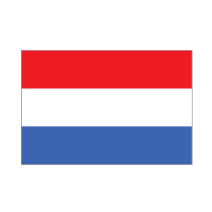
Brightlines provides Dutch translation services to UK and international clients in Netherlands Dutch and Flemish Dutch (Belgian Dutch). Work covers brand and marketing copy, software localisation and legal and compliance documentation for Dutch and Belgian markets. It also includes financial services communications for UK firms with regulatory obligations in Amsterdam, plus operational content for Dutch-speaking workforces. Each project is matched to the right regional variety, formality level and register.
Dutch at a glance
- Script: Latin alphabet. Dutch uses the digraph ij, which functions as a single character and is capitalised as IJ at the start of proper nouns and sentences.
- Speakers: Approximately 25 million native speakers, primarily in the Netherlands and Flanders (the Dutch-speaking region of Belgium). Dutch is also an official language of Suriname.
- Varieties: Netherlands Dutch and Flemish Dutch share a written standard based on Netherlands norms, but diverge in vocabulary, formality conventions and some grammatical preferences, particularly in formal and professional contexts.
- Address forms: Dutch uses formal u and informal jij/je (both meaning "you"). In the Netherlands, jij/je is now standard in consumer marketing and most professional contexts. Flanders more commonly retains u in business and official communications.
- Diminutives: forms such as kopje, melkje and autootje (diminutives of the words for cup, milk and car) signal warmth, casualness or familiarity. Their register varies between Netherlands and Flemish usage, so brand and marketing copy must handle them intentionally.
- Compound words: Dutch forms compound nouns freely to create precise descriptive terms (treinstation, "train station"; openluchtmuseum, "open-air museum"). Translators need a working command of compounding conventions to avoid inelegant or non-idiomatic constructions.
- Translation risk: two errors recur. One is applying Netherlands-standard register to a Flemish audience. The other is importing British-style informality that reads as presumptuous in markets where professional distance is still expected.
When Dutch translation needs more than accuracy
Netherlands Dutch and Flemish Dutch expect different professional registers
The Netherlands and Belgium share a written standard but diverge significantly in how formal professional communication should sound. Flemish formal writing tends toward a more elevated register than its Netherlands equivalent, so consumer copy written for Amsterdam will not land the same way in Antwerp. The difference is social calibration, not vocabulary.
The u or jij/je choice signals whether a brand belongs to the reader's world
Choosing between u (formal) and jij/je (informal) is never a neutral stylistic decision. Netherlands consumer copy now defaults to jij/je in most sectors, while Flanders more commonly retains u, particularly in banking, healthcare and government communications. The wrong form does not offend Dutch or Flemish readers. It marks the brand as not quite local.
Dutch directness needs deliberate register management, not literal transfer
Dutch professional culture values direct, unhedged communication. The softening that is conventional in British English reads as evasive or unclear in Dutch. The same judgement applies in reverse: over-softening Dutch business correspondence to meet British politeness conventions produces an English translation that misrepresents the original intent.
False cognates look identical and mean different things
Dutch and English share Germanic roots, so many Dutch words resemble English ones while carrying different meanings. Eventueel means "possibly", not "eventually". Brutaal means "rude", not "brutal". Actueel means "current", not "actual". Slim means "clever", not "slender". These are among the most common Dutch translation errors and the hardest to catch in QA, because the wrong word reads as plausible to a non-native reviewer.

AI suitability for Dutch translation
Raw AI output is not publishable for Dutch content without human review. AI tools are more reliable for Netherlands Dutch than for Flemish, but fluent output is not the same as output that is right for the audience. They default to Netherlands norms and cannot judge address form, formality level or Netherlands/Flemish register without knowing the target audience and the brand. For Flemish Dutch, regional vocabulary and formality conventions are reproduced less consistently, and the errors are not always visible without native knowledge of the variety. Flemish content therefore goes to a reviewer matched to Flanders, and Netherlands content to one matched to the Netherlands.
How clients use our Dutch translation services
- Brand and marketing copy: consumer and B2B copy for Netherlands Dutch and Flemish audiences. The two markets differ in register conventions, address forms and tonal expectations, which makes this Creative Translation work. Content written for Amsterdam will not land the same way in Antwerp, so Brightlines treats each as a separate brief.
- Software, app and digital product localisation: UI strings, help documentation, error messages and in-app copy for products entering Dutch and Belgian markets. Specialist Led Translation keeps terminology consistent across every string and handles the Netherlands and Flemish vocabulary differences that matter at character level. The Netherlands is one of Europe's leading technology markets, where generic pan-European localisation fails on arrival.
- Financial services communications: investor reports, fund documentation, regulatory filings and client communications for UK financial institutions operating in Amsterdam or serving Dutch-speaking clients. With jurisdiction-specific terminology and post-Brexit obligations in play, this calls for Specialist Led Translation by translators who know Dutch financial convention as well as the language.
- Legal and compliance documents: contracts, regulatory filings and certified translations for Dutch and Belgian organisations. The Dutch and Belgian legal frameworks differ materially, so translating without jurisdictional knowledge creates compliance risk. Specialist Led Translation brings that knowledge.
- Operational and internal content at volume: FAQs, HR policies, training documentation and internal communications for Dutch-speaking workforces in the Netherlands, Belgium or the UK. Smart Translation keeps high-volume material efficient, with the Netherlands/Flemish variant agreed before work begins and every output reviewed by a Dutch translator before delivery.
What you get with Brightlines
Dutch and Flemish market expertise
For you: translators with commercial knowledge of the Dutch and Flemish markets as well as language qualifications.
Each Dutch translator on a Brightlines project holds professional experience in the relevant regional market and content sector. A Netherlands consumer marketing specialist knows how Dutch audiences respond to register and address forms. A Flemish legal translator knows Belgian legal convention. Territory and sector both decide who takes the work.
Human-led quality with regional and register precision
For you: regional variety and register accuracy confirmed before delivery.
A human review stage checks every Dutch translation for regional consistency, address form and formality level against the project brief. AI tools support the workflow where appropriate, but a qualified human translator checks each project before it leaves Brightlines, whatever the volume, deadline or content type.
Dutch copy assessed for directness
For you: Dutch copy that sounds written for the audience, not exported to them.
Brand and marketing content is translated with knowledge of how Netherlands and Flemish audiences respond to tone and register. When a UK brand enters a Dutch or Belgian market, its copy is checked for linguistic accuracy and for whether it will land as intended. Technically accurate Dutch can still fail if it feels out of step with local expectations.
Get a quote for Dutch translation services in the UK
Dutch translation at Brightlines covers marketing, software, financial, legal and operational content. Every project is matched to Netherlands or Flemish Dutch at the right register and tier. Talk to us about your project.


Sound local in every language.
If your content has to sell, persuade, reassure, or build trust, the choices between the words matter. We keep a human in control on every project, then use supportive tools only where they genuinely help. The result is writing that reads cleanly, stays consistent, and sounds like you, not a template.

Industry Experience

International Reach

Speed & Accuracy
Supported
Languages
We support a wide range of languages, from major global markets to specialist regional languages.